
As the fintech industry continues to grow, its dependency on technology is increasing at an unprecedented pace.
Today, the operations of a fintech company depend on a broad technology ecosystem that includes mobile applications, APIs, cloud infrastructure, payment systems, identity and authentication services, third-party providers, and highly sensitive financial data.
As a result, information security is no longer simply an IT responsibility.
For fintech companies, particularly payment and electronic money institutions, information security has become a governance issue that affects management, risk management, business continuity, software development, third-party relationships, operations, and regulatory compliance.
The regulatory landscape is evolving accordingly.
Information Security Management Is No Longer Just About ISO 27001
Having an ISO/IEC 27001 certification is an important achievement for a fintech company.
However, from a regulatory and operational perspective, certification alone is not enough.
Organizations are increasingly expected not only to have policies and procedures, but also to demonstrate that their controls are actually implemented and operating effectively.
This includes:
- Identifying and classifying information assets
- Conducting regular risk assessments
- Identifying critical systems and services
- Controlling access to sensitive information
- Monitoring security logs
- Responding to cybersecurity incidents
- Maintaining business continuity
- Integrating security into software development
- Managing third-party and outsourcing risks
- Performing security testing and independent assessments
- Demonstrating evidence of control effectiveness
This leads to a fundamental shift in the way BGMS should be approached:
From document-driven security to continuously operating, measurable, and auditable security governance.
Why Is the Regulatory Framework Important for Fintech Companies?
Not every company within the fintech ecosystem is subject to the same regulatory requirements.
In Türkiye, payment and electronic money institutions are subject to specific regulations issued by the Central Bank of the Republic of Türkiye (CBRT), while banks operate under the regulatory framework of the Banking Regulation and Supervision Agency (BRSA).
Depending on their activities, organizations may also need to consider data protection, cybersecurity, outsourcing, independent audit, business continuity, and other regulatory requirements.
For this reason, one of the first questions a fintech company should answer before launching a BGMS program is:
“Which regulations and regulatory authorities apply to our organization?”
Without clearly answering this question, even a technically mature security program can contain significant compliance gaps.
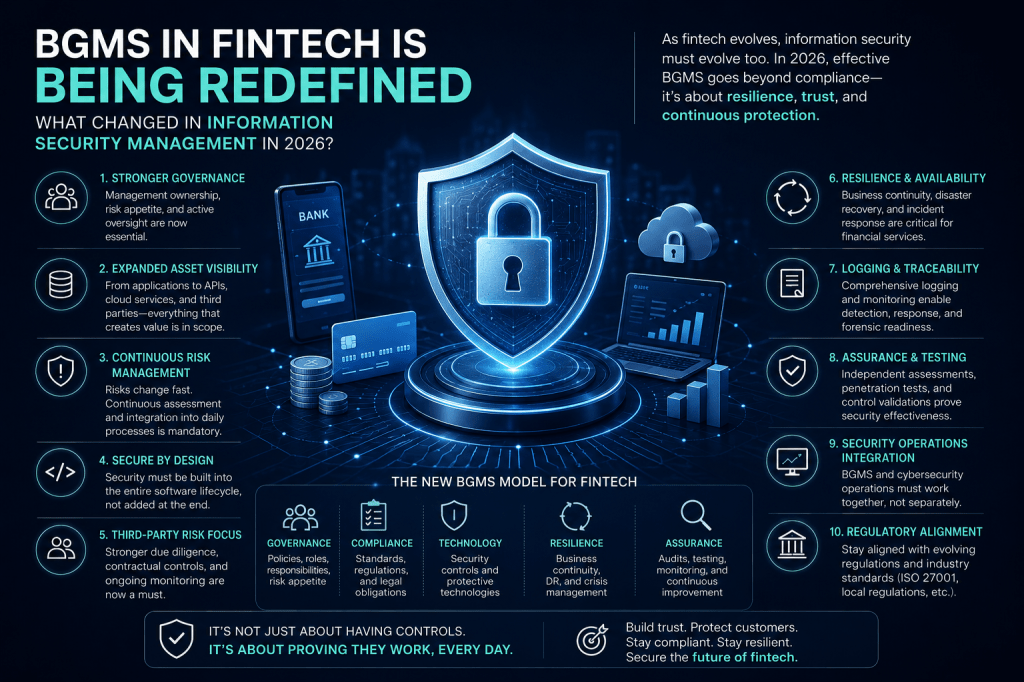
1. Management Responsibility Is Becoming More Critical
Information security can no longer be treated solely as an IT or cybersecurity department responsibility.
Fintech management should actively participate in:
- Establishing and approving information security policies
- Defining risk appetite
- Identifying critical information assets and services
- Supporting security investments
- Reviewing security and audit findings
- Monitoring remediation activities
This approach is also closely aligned with the management principles of ISO/IEC 27001.
A policy approved by senior management but not implemented in daily operations does not represent an effective BGMS.
Governance must translate into operational reality.
2. Asset Inventory Must Be Considerably Broader
In a traditional information security program, servers, computers, network devices, and applications may be considered the primary assets.
In fintech environments, the picture is much broader.
Critical assets may include:
- Mobile applications
- Web applications
- APIs and API gateways
- Payment platforms
- Virtual POS infrastructure
- Core financial applications
- Databases
- Cloud services
- CI/CD platforms
- Source code repositories
- Identity and authentication systems
- HSM and cryptographic infrastructure
- SIEM and logging platforms
- Customer information
- Transaction data
- Third-party APIs
Therefore, a fintech asset inventory should not simply answer:
“What technology do we have?”
It should answer:
“Which technologies, data, applications, and services are critical to delivering our financial services?”
3. Cyber Risk Management Is Moving to the Center of BGMS
Risk assessment should not be treated as an annual spreadsheet exercise.
Consider a fintech company introducing a new payment API.
The organization should evaluate:
- API security
- Authentication
- Authorization
- Rate limiting
- Data exposure
- Third-party dependencies
- Logging
- Monitoring
- Incident detection
This means information security risk management should be integrated into change management, project management, software development, and business processes.
Risk management must become continuous rather than periodic.
4. Secure Software Development Is Now a Critical Control Area
For many fintech companies, software is one of their most important assets.
Security therefore cannot be introduced only after software development has been completed.
Security should be integrated throughout the entire lifecycle:
Requirements → Design → Development → Testing → Deployment → Monitoring
This includes practices such as:
- Secure SDLC
- DevSecOps
- Secure coding
- Dependency management
- Secrets management
- SAST
- DAST
- API security
- Software vulnerability management
For fintech organizations providing internet-based financial services, application security and information security governance should not be managed as completely separate disciplines.
5. Third-Party and Cloud Risk Are Becoming Major Security Concerns
Fintech companies increasingly depend on external providers, including:
- Cloud service providers
- SaaS platforms
- Payment infrastructure providers
- KYC/AML service providers
- SMS and email providers
- Identity verification services
- API providers
- Software development companies
- SOC/MDR providers
The key question is no longer simply:
“Does the supplier have an ISO 27001 certificate?”
More meaningful questions include:
Where is our data stored?
Who can access it?
How quickly will we be notified of a security incident?
Do we have audit rights?
How will our data be returned or securely deleted when the contract ends?
What happens if the supplier becomes unavailable?
Third-party risk management is therefore becoming an integral component of information security governance and operational resilience.
6. Business Continuity and Disaster Recovery Are Becoming More Important
For a fintech company, service availability can be just as important as confidentiality and integrity.
If a payment service becomes unavailable for several hours, the consequences may go far beyond a technical incident.
Potential impacts include:
- Financial losses
- Customer dissatisfaction
- Reputational damage
- Contractual consequences
- Regulatory exposure
Therefore, BGMS should be closely integrated with:
- Recovery Time Objectives (RTO)
- Recovery Point Objectives (RPO)
- Critical business processes
- Critical applications
- Backup strategies
- Disaster recovery
- Crisis management
- Business continuity testing
A fintech security program must ultimately protect not only information, but also the organization’s ability to continue operating.
7. Logging and Traceability Are Critical
Simply saying “we collect logs” is not enough.
The real question is whether the organization can determine:
What happened, where it happened, when it happened, which account performed the action, and what the outcome was.
This makes centralized logging, SIEM, privileged user monitoring, critical transaction logging, log integrity, and appropriate retention increasingly important.
In the event of fraud or a cyberattack, security operations and BGMS must be able to work together.
The ability to reconstruct an incident can be just as important as detecting it.
8. Independent Assessments and Security Testing Matter More
In financial services, organizations cannot rely exclusively on internal assessments to determine whether their security controls are effective.
Independent assessments, technical security testing, and control effectiveness reviews are becoming increasingly important.
Depending on the organization’s risk profile, this may include:
- Penetration testing
- Vulnerability assessments
- Web application security testing
- API security testing
- Mobile application security testing
- Social engineering assessments
- Configuration reviews
- Access control reviews
- Privileged access assessments
For regulated fintech organizations, these activities should form part of a structured, risk-based security assurance program.
9. BGMS and Cybersecurity Operations Are Converging
Historically, information security management was sometimes viewed primarily through questions such as:
Are the policies documented?
Has the risk assessment been completed?
Are the procedures available?
The modern approach asks different questions:
Does the control actually work?
What evidence demonstrates that it works?
How did the organization respond to the last security incident?
How quickly are critical vulnerabilities remediated?
Are critical systems continuously monitored?
This is where BGMS needs to connect with operational security capabilities such as:
- SOC
- SIEM
- EDR
- IAM
- PAM
- DLP
- WAF
- MFA
- Vulnerability Management
A mature information security management system should not exist independently from the organization’s cybersecurity operations.
10. A New BGMS Model for Fintech Companies
Considering all these developments together, fintech BGMS can be viewed through five interconnected layers:
1. Governance
Policies, responsibilities, management oversight, risk appetite, and accountability.
2. Compliance
ISO/IEC 27001, data protection requirements, regulatory requirements, and sector-specific obligations.
3. Technology
IAM, PAM, SIEM, EDR, WAF, DLP, MFA, encryption, secure software development, and network security.
4. Resilience
Business continuity, disaster recovery, backup, crisis management, and operational resilience.
5. Assurance
Internal audits, independent assessments, penetration testing, vulnerability management, and control effectiveness measurement.
Together, these five layers form the foundation of a mature fintech information security management program.
What Should Fintech Companies Do Today?
The first step should not necessarily be writing another policy.
The first step should be understanding the current state.
A fintech company should be able to answer:
- Which regulations apply to us?
- What are our critical information assets?
- What are our critical business processes?
- What types of data do we process?
- Where is our data stored?
- Which third parties do we depend on?
- How long can critical services remain unavailable?
- When was our last penetration test?
- How quickly are critical vulnerabilities remediated?
- How are privileged accounts managed?
- Are our logs centrally monitored?
- Do we have an effective incident response capability?
- Can we demonstrate that our security controls are actually operating?
If these questions cannot be answered clearly, having an ISO 27001 certificate alone does not necessarily mean that an organization has achieved effective information security management.
Conclusion
Information security in fintech should no longer be treated simply as a certification project.
As regulatory expectations, technological dependencies, and cyber threats continue to evolve, BGMS is becoming a living management system that brings together:
Governance + Risk + Technology + Operations + Resilience + Assurance
For fintech organizations, particularly those operating in regulated financial services, the real value of an information security management system is not measured by the number of policies or certificates an organization possesses.
It is measured by its ability to protect sensitive information, maintain critical services, manage cyber risk, demonstrate regulatory compliance, and respond effectively when something goes wrong.
Therefore, the most important question in 2026 is no longer:
“Do we have an ISO 27001 certificate?”
The better question is:
“Do our information security controls actually work — and can we prove it when required?”
Because the value of a modern BGMS is no longer determined by the documents it contains.
It is determined by how effectively it enables an organization to operate securely, resiliently, measurably, and continuously.
 Secure Your Digital World
Yorum bırakın