
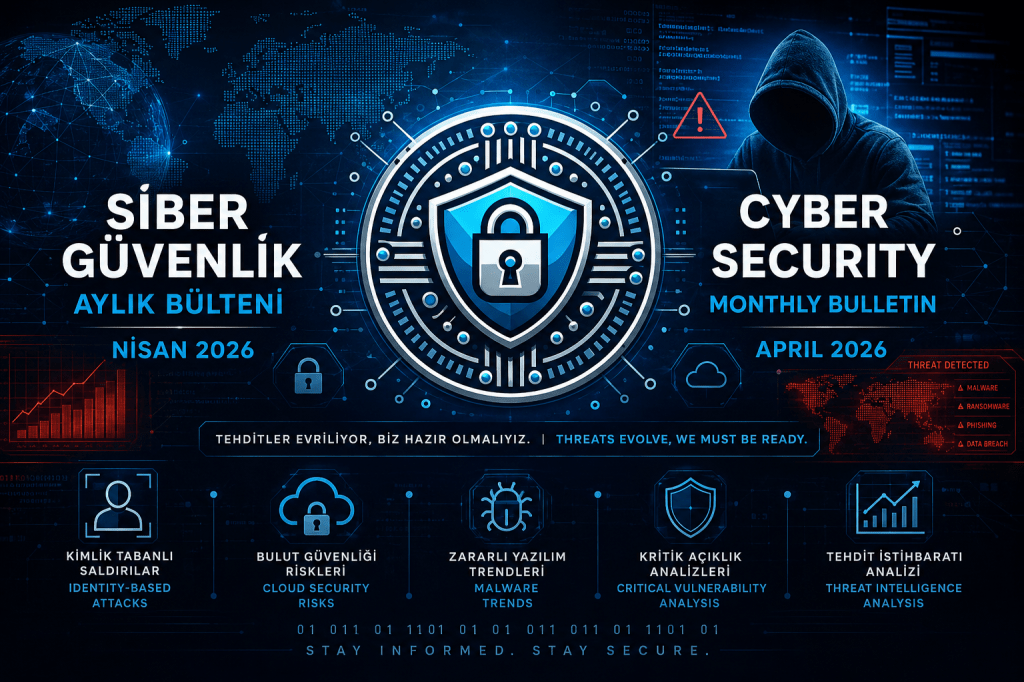
April 2026 Cyber Threat Intelligence Report
April 2026 highlighted a significant rise in identity-focused attacks, cloud infrastructure targeting, and low-noise intrusion techniques across the global cyber threat landscape. OAuth abuse, session token theft, MFA bypass techniques, and infostealer malware campaigns continued to pose serious risks for enterprise environments.
Modern threat actors are no longer relying solely on traditional exploitation techniques. Instead, they are increasingly focusing on user sessions, authentication mechanisms, access tokens, and trust relationships to gain persistence and maintain unauthorized access within corporate infrastructures.
Executive Summary
Key developments observed throughout April 2026 include:
- Significant increase in identity-based attacks
- Widespread abuse of OAuth permissions and session tokens
- Growing attacks targeting cloud infrastructures
- Rapid expansion of infostealer malware campaigns
- Continued evolution of ransomware groups toward data extortion operations
The extensive use of valid accounts in attack chains once again demonstrated the limitations of traditional perimeter-based security models.
Threat Landscape
Rise of Identity-Based Attacks
Threat actors increasingly preferred identity compromise techniques over direct system exploitation. Common methods included:
- MFA fatigue attacks
- OAuth permission abuse
- Session token hijacking
- Credential theft operations
These techniques enabled attackers to operate with minimal visibility while bypassing many traditional detection mechanisms.
Cloud Security Risks
Several critical cloud-related risks were observed during April 2026:
- Misconfigured IAM policies
- Publicly exposed cloud storage services
- Weak API security controls
- Limited cloud logging visibility
SaaS platforms and hybrid cloud environments continued to be high-priority targets for attackers.
Supply Chain and Third-Party Risks
Attacks involving third-party integrations and external service providers increased significantly.
Notable risks included:
- Compromised vendor accounts
- API trust abuse
- Software dependency manipulation
This trend clearly demonstrates that organizations must evaluate not only their own infrastructure but also the security posture of their partners and suppliers.
Top 10 Cyber Incidents of April 2026
1. Enterprise OAuth Permission Abuse
- Attack Vector: Rogue OAuth application
- Impact: Account takeover and unauthorized data access
2. Financial Sector Phishing Operation
- Attack Vector: MFA fatigue combined with phishing
- Impact: Unauthorized enterprise access
3. Cloud Storage Data Exposure
- Attack Vector: Publicly accessible cloud storage
- Impact: Sensitive data disclosure
4. Infostealer Malware Campaign
- Target: End-user systems
- Objective: Browser and session data theft
5. SaaS Administrative Account Compromise
- Attack Vector: Session hijacking
- Impact: Privilege escalation
6. Healthcare Sector Ransomware Attack
- Impact: Operational disruption and data encryption
7. API Key Exposure Incident
- Attack Vector: Misconfigured code repository
- Impact: Unauthorized service access
8. DDoS Attack Against Educational Institution
- Impact: Service interruption
9. Corporate VPN Credential Abuse
- Attack Vector: Credential stuffing
- Impact: Unauthorized network access
10. Mobile Malware Campaign
- Target: Android devices
- Objective: Credential and financial data theft
Critical Vulnerabilities
| CVE | System | Risk |
| CVE-2026-XXXX | Microsoft Exchange | Privilege Escalation |
| CVE-2026-XXXX | Chrome | Remote Code Execution |
| CVE-2026-XXXX | VMware ESXi | Authentication Bypass |
| CVE-2026-XXXX | Cisco ASA | Unauthorized VPN Access |
Malware of the Month
Infostealer-as-a-Service (IaaS)
A substantial increase in infostealer malware campaigns was observed throughout April 2026.
Key capabilities included:
- Browser credential harvesting
- Session token theft
- Cryptocurrency wallet targeting
- Cloud credential collection
These malware campaigns were commonly distributed through:
- Fake software update pages
- Phishing operations
- Pirated software packages
Threat Intelligence Analysis
Threat intelligence data collected during April 2026 clearly indicates a strategic shift from exploit-driven operations toward identity and access-focused attack models.
Dominant Attack Techniques
The following attack patterns were widely observed:
- Identity compromise-focused attacks
- Living-off-the-Land (LotL) techniques
- Session and token-based persistence
- Low-visibility operations
- Cloud-native attack methodologies
MITRE ATT&CK Mapping
Observed attack patterns strongly aligned with the MITRE ATT&CK framework.
Initial Access
- T1566 – Phishing
- T1078 – Valid Accounts
Execution
- T1059 – Command and Scripting Interpreter
Persistence
- T1098 – Account Manipulation
- T1550 – Use of Authentication Tokens
Credential Access
- T1003 – Credential Dumping
- T1555 – Credentials from Password Stores
Defense Evasion
- T1070 – Indicator Removal
- T1027 – Obfuscated Files or Information
Exfiltration
- T1567 – Exfiltration Over Web Services
Adversary Tradecraft Analysis
Several operational trends among threat actors became increasingly visible during April 2026:
- Growing use of Initial Access Brokers (IABs)
- Expansion of Phishing-as-a-Service (PhaaS) ecosystems
- Increased focus on long-term persistence strategies
- Adoption of multi-stage attack chains
- Lateral movement attempts within cloud infrastructures
Detection and Visibility Gaps
The following defensive weaknesses were frequently identified during incident analysis:
- Insufficient cloud audit logging
- Lack of OAuth activity monitoring
- Limited visibility into token-based authentication
- Weak SIEM correlation rules
- Inadequate API activity monitoring
SOC and Detection Engineering Notes
Recommended Detection Use Cases
Suspicious OAuth Activity
- Newly granted OAuth application permissions
- Unusual consent operations
Token Abuse Detection
- Same token used from multiple IP addresses
- Impossible travel login patterns
Credential Stuffing Detection
- High-volume failed authentication attempts
- VPN brute-force behaviors
Cyber Security Statistics
- Total published CVEs: ~3400
- Critical vulnerability ratio: 21%
- Most targeted sectors: Finance and Healthcare
- Most common attack type: Phishing and identity abuse
- Fastest growing threat: Infostealer malware
Security Recommendations
Key recommendations for enterprise security teams:
- Strengthen MFA policies
- Regularly audit OAuth permissions
- Improve cloud logging visibility
- Optimize SIEM and EDR integrations
- Actively utilize UEBA systems
- Conduct regular API security assessments
Final Assessment
April 2026 clearly demonstrated that modern cyber threats are increasingly centered around identity, access, and trust relationships.
Organizations must transition their security strategies: from network-centric security models to identity-centric security architectures in order to effectively defend against evolving cyber threats.
 Secure Your Digital World
Yorum bırakın