
1. Introduction
Artificial Intelligence (AI) has not only transformed business processes in recent years but has also brought significant changes to the field of cybersecurity. Today, attackers go beyond traditional methods by leveraging AI-powered attacks. These attacks pose serious threats in terms of both speed and scale. On the other hand, AI also provides defenders with powerful capabilities, such as early threat detection, analysis, and automated response.
2. Types of AI-Powered Cyber Threats
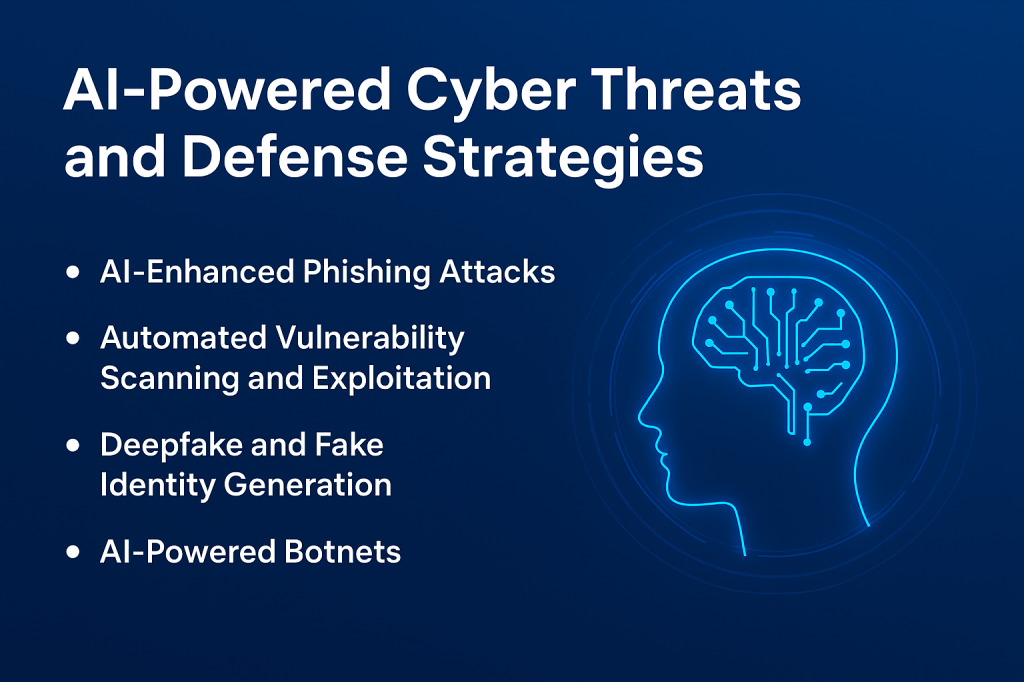
2.1. AI-Enhanced Phishing Attacks
Traditional phishing attacks have become far more convincing with the help of AI. By analyzing a target’s social media activity, email patterns, and behavior, AI can craft highly personalized messages. Deepfake audio and video technology can be used to impersonate executives through fake meeting invitations or phone calls.
2.2. Automated Vulnerability Scanning and Exploitation
Attackers can use AI to automatically scan target systems for vulnerabilities. What used to take hours can now be done in minutes, and discovered weaknesses can be exploited almost instantly.
2.3. Deepfake and Fake Identity Generation
AI-generated fake identities can bypass security cameras, biometric verification systems, and identity checks. This is a major threat for sectors such as finance and border security.
2.4. AI-Powered Botnets
Machine learning-powered botnets constantly change their network behavior, making detection difficult. This enables more effective and harder-to-stop DDoS attacks.
2.5. Evading Security Measures
AI can be used to bypass spam filters, solve CAPTCHAs, and evade antivirus software, leaving traditional security solutions insufficient on their own.
3. AI-Based Defense Strategies
3.1. AI-Powered Threat Detection
Machine learning-based security systems can learn normal network behavior and quickly detect anomalies, identifying even previously unknown attack types in their early stages.
3.2. Real-Time Incident Response
When a threat is detected, AI can automatically quarantine malicious files, block suspicious IP addresses, or send instant alerts to administrators.
3.3. Cyber Threat Intelligence
AI can process millions of data points from multiple sources to predict potential attack scenarios, allowing organizations to take preventive measures before an attack occurs.
3.4. Deep Packet Inspection and Machine Learning
AI-powered Deep Packet Inspection (DPI) can analyze network traffic in detail and detect suspicious activity more effectively.
3.5. Employee Awareness Training
AI-based simulations can expose employees to realistic social engineering scenarios, continuously testing and improving security awareness levels.
4. Future Perspective
AI-powered cyber threats will continue to evolve in the coming years. Organizations must focus not only on technological solutions but also on ethical guidelines, regulatory compliance, and strengthening the human factor. Hybrid security models that combine human expertise with AI will be the most effective defense approach in the future.
5. Conclusion
AI is like a double-edged sword in the world of cybersecurity. In the wrong hands, it is a powerful weapon for attackers; in the right hands, it becomes an effective defense mechanism. The best strategy is to adopt an integrated security approach that combines human experience with the power of artificial intelligence.


 Secure Your Digital World
Yorum bırakın